Why Restaurant Owners Choose Retail Furniture Over Commercial Manufacturers
Why Restaurant Owners Choose Retail Furniture Over Commercial Manufacturers
Restaurant and nightclub owners often leave furniture purchasing until the final stage of their project. With construction, kitchen equipment, staffing, and permits taking priority, restaurant furniture decisions are sometimes rushed.
When time is limited, many owners turn to local retail stores or online platforms like Amazon. The options look appealing—modern restaurant chairs, stylish bar stools, and sleek tables at competitive prices. Many listings even claim to be “commercial grade.”
But this is where the mistake begins.
Retail furniture is designed for residential use, not for the daily demands of a high-traffic restaurant. While the products may look similar, the internal construction, materials, and durability are completely different.
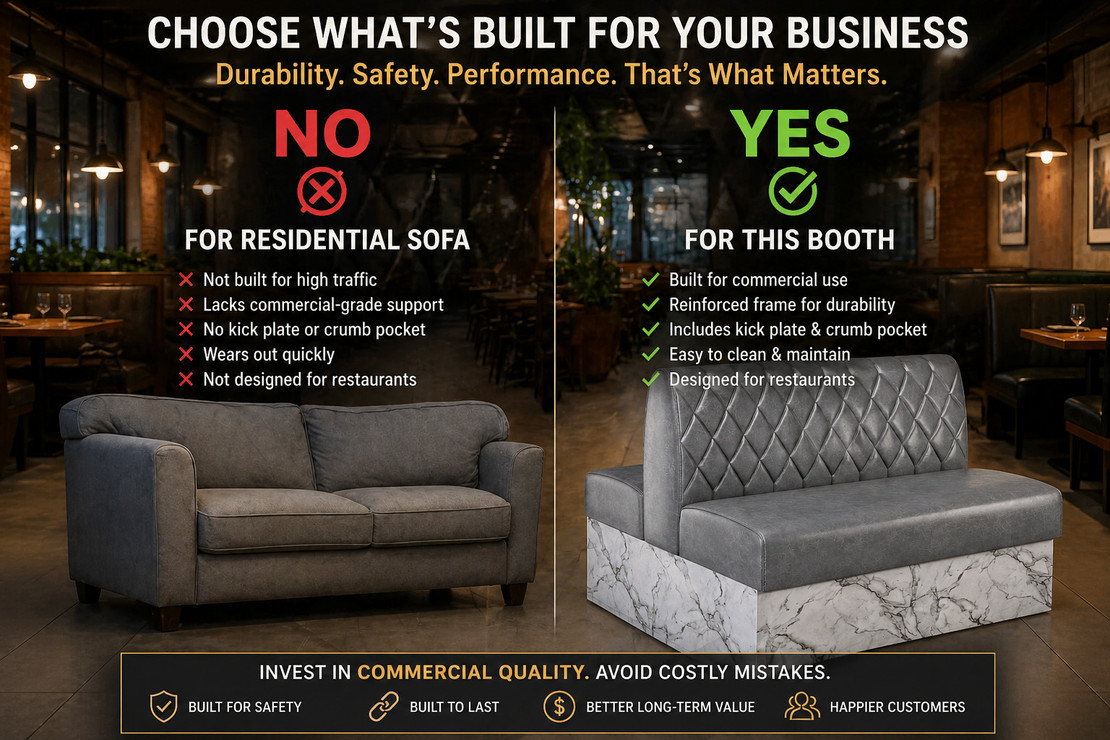
Take restaurant booths as an example. True commercial booths include reinforced frames, toe-kick panels, crumb pockets, and laminate platforms—features designed for durability and easy maintenance. Replacing them with residential-style couches may seem like a shortcut, but it quickly becomes a costly mistake. These pieces are not built for continuous use and will wear out much faster.
Another major misconception involves restaurant table tops. Many buyers assume they are simply flat surfaces that can be purchased anywhere as long as the size fits. In reality, commercial restaurant table tops are engineered with specialized materials that are scratch-resistant, heat-resistant, and water-resistant. Retail alternatives often lack these properties, leading to issues such as warping, peeling, or surface damage within just a few months of use.
As noted by Jennifer Perez, another common mistake is selecting lightweight bar stools without proper structural support. Commercial bar stools are designed with reinforced frames and welded stretchers to support weight capacities of up to 300–350 lbs. Retail versions may look similar but are not built to handle this level of use safely.
Choosing the wrong furniture doesn’t just lead to faster wear—it can create operational issues, customer dissatisfaction, and even safety risks.
Experienced operators understand that investing in properly built commercial restaurant furniture from U.S. manufacturers provides long-term value. These manufacturers design products specifically for commercial environments, ensuring durability, consistency, and compliance with industry standards.
What seems like a cost-saving decision upfront often leads to higher expenses, replacements, and unnecessary stress later.
Q1: Why do restaurant owners choose retail furniture instead of commercial furniture?
A: Many owners are pressed for time and assume retail products will perform the same. Retail stores and online platforms make purchasing quick and convenient, but they often do not provide true commercial-grade durability.
Q2: What is the biggest difference between retail and commercial restaurant furniture?
A: Commercial restaurant furniture is built for high-traffic use with reinforced construction and durable materials. Retail furniture is designed for residential use and typically cannot withstand constant wear and tear.
Q3: Are restaurant table tops different from regular tables?
A: Yes. Commercial restaurant table tops are made with materials that resist scratches, heat, and moisture. Retail table surfaces may warp, peel, or degrade quickly under restaurant conditions.
Q4: What should I look for when buying bar stools?
A: Choose bar stools with solid frames, welded stretchers, and a weight capacity of at least 300–350 lbs. This ensures stability, safety, and long-term performance.
Q5: Is buying from a U.S. manufacturer worth it?
A: Absolutely. U.S. manufacturers specialize in commercial restaurant furniture, offering better quality control, customization, and long-term reliability compared to retail options.