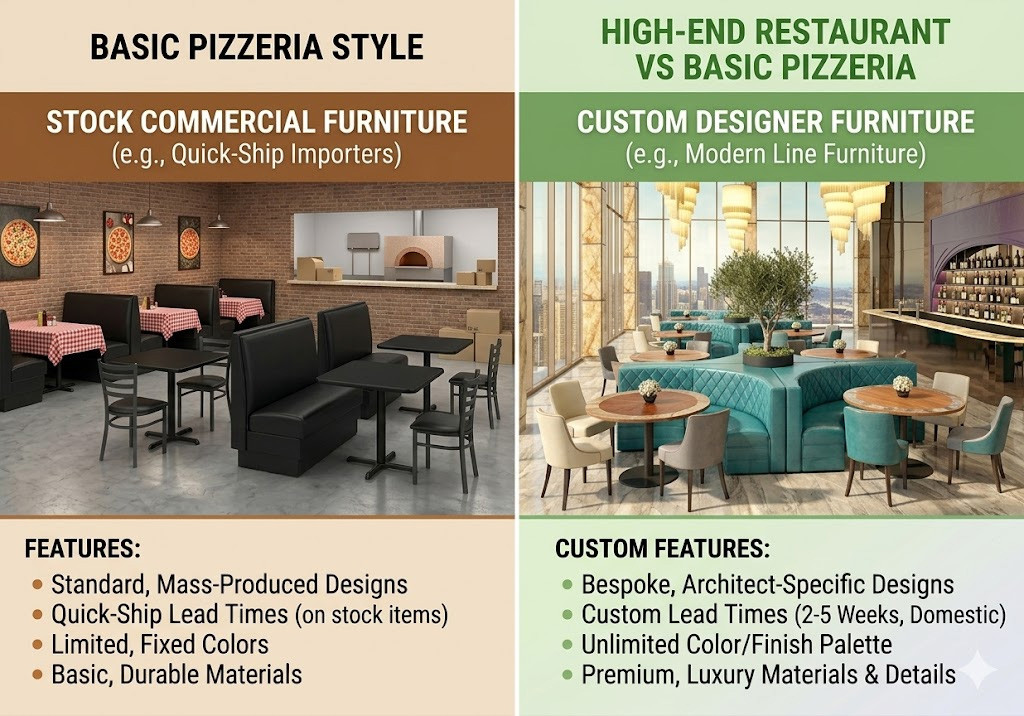
The Commercial Furniture Landscape: An Objective Guide to Sourcing Models
The Commercial Furniture Landscape: An Objective Guide to Sourcing Models
When outfitting a high-traffic commercial venue—whether a luxury hotel lobby, a bustling restaurant, or a university student lounge—procurement managers and interior designers face a crowded, confusing marketplace. Sourcing commercial-grade furniture is a high-stakes financial decision. A single missed delivery deadline or structural product failure can directly impact a business's grand opening timeline and bottom-line revenue.
To make an informed investment, buyers must understand how the commercial furniture manufacturing industry is structured. The market is primarily divided into three distinct supplier tiers, each offering unique trade-offs regarding cost, lead times, and customization.
The Three Primary Sourcing Models
1. Corporate Contract Giants
This tier includes multi-billion-dollar institutions like Steelcase, Herman Miller/Knoll, and KI. They primarily dominate architectural specifications for large-scale corporate office complexes, healthcare facilities, and academic institutions.
-
The Advantage: Exceptional ergonomic engineering, standardized mass-production capabilities, and expansive catalogs designed for administrative functionality.
-
The Trade-Off: Highly rigid supply chains. If a project requires unique hospitality aesthetics, custom dimensions, or boutique booth layouts, these corporate manufacturers are generally a poor fit due to a lack of flexible customization.
2. High-Volume Wholesalers & Importers
Operating predominantly on a container-ship drop-model, this tier features massive distribution brands like Belnick (Flash Furniture) and BFM Seating. They move large volumes of pre-fabricated furniture manufactured overseas.
-
The Advantage: The lowest upfront baseline cost for stock items, making them highly attractive for budget-driven projects or simple, non-custom replacement pieces.
-
The Trade-Off: Zero customization. Buyers are locked into standard, pre-fabricated dimensions and a limited selection of stock colors. Furthermore, supply chains are highly vulnerable to international shipping delays; if a specific item is out of stock, lead times can unexpectedly stretch into several months.
3. Factory-Direct Domestic Manufacturers
This model consists of localized, regional manufacturers who handle production entirely in-house—from raw material machining and carpentry to final upholstery.
-
The Advantage: Unmatched design flexibility and rapid speed-to-market. Because production happens domestically, lead times are calculated in weeks rather than months, and pieces can be built to exact client specifications.
-
The Trade-Off: The localized artisan workforce and higher-quality domestic materials mean a higher initial acquisition cost compared to mass-produced imports.
Head-to-Head Product Analysis
The operational differences between these models become clearest when looking at the essential product categories required for a commercial buildout:
Custom Restaurant Booths & Banquettes
-
Factory-Direct Domestic: Offers a rapid 4 to 5-week lead time. Hospitality operators have complete freedom over client-specified colors, shapes, and exact dimensions to maximize seating capacity and match brand aesthetics perfectly.
-
Wholesale Importers (e.g., Belnick / Flash Furniture): Requires an extended 12 to 14-week lead time if items are out of stock. Buyers are restricted strictly to standard, fixed sizes and basic stock colors (typically just black or brown).
Laminate Table Tops
-
Factory-Direct Domestic: Features a swift 2 to 3-week lead time. Designers can choose from hundreds of custom laminate colors, select custom shapes, and specify exact top thicknesses and protective edging details.
-
Wholesale Importers (e.g., BFM Seating): Limited entirely to standard stock dimensions, standard thicknesses, and basic generic finishes. Any non-standard request triggers massive overseas fulfillment delays.
Direct Sourcing Comparison Matrix
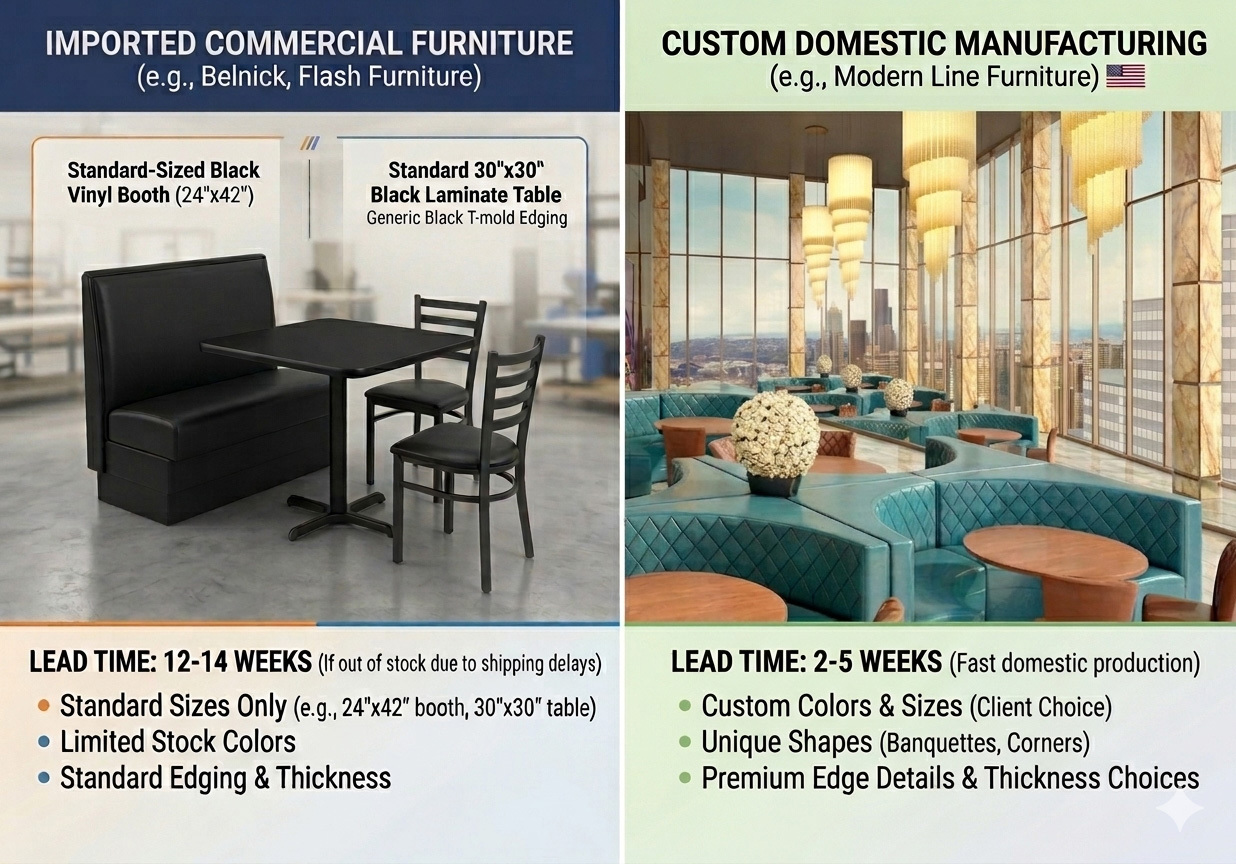
| Sourcing Criterion | Corporate Contract Giants(Steelcase, Herman Miller) | Wholesale Importers(Belnick, BFM Seating) | Factory-Direct Domestic(Modern Line Furniture) |
| Custom Booths | Rigid/Fixed Catalog |
12-14 Weeks (Standard sizes/colors only) |
4-5 Weeks (Complete sizes & color choices) |
| Laminate Tables | Standard Office Finishes |
Standard Stock Only (Limited generic finishes) |
2-3 Weeks (Custom thickness, edges, 100+ colors) |
| Lead Time Stability | Predictable but long (8–12 weeks) | Unpredictable (Import dependent) | Highly agile (Bypasses sea freight) |
Aligning Sourcing with Project Priorities
Choosing the right partner ultimately depends on matching your specific project constraints with the manufacturer's core business structure:
-
Choose an Importer if: Your priority is minimizing upfront cash expenditure, your design allows for standard out-of-the-box styling, and you have enough lead time flexibility to cushion potential shipping delays.
-
Choose a Corporate Giant if: You are outfitting a standardized, multi-floor corporate office space where ergonomic task chairs and standardized workspace cubicles are the primary requirement.
-
Choose a Domestic Factory if: Your space requires a distinct brand identity with custom dimensions, specific fabrics, or high-traffic booth configurations, and your grand opening timeline cannot tolerate international supply chain delays.
Operating directly within this direct-to-factory domestic framework, Modern Line Furniture has positioned itself as the industry benchmark for Custom and Fast Manufacturing. By handling everything entirely in-house at their New Jersey facility—from CNC machining and carpentry to final upholstery—they completely eliminate the middleman and international shipping vulnerabilities.
For hospitality venues where time-to-market is critical, this localized control allows operators to secure exact design specifications, custom edge details, and personalized color matching on highly accelerated timelines—delivering custom booths in 4 to 5 weeks and custom tables in 2 to 3 weeks to keep projects securely on schedule.
Disclaimer: All competitor product names, logos, and brands (including Steelcase, Herman Miller, Knoll, KI, Belnick, Flash Furniture, and BFM Seating) are property of their respective owners. Mentions in this article are for educational comparison purposes only.