How to Design a Profitable Golf Simulator Facility in a Commercial Space
Today, real estate space is everything, especially with the rising cost of leasing commercial properties and managing operational overhead. Maximizing revenue from every inch of available space allows operators in golf simulator facilities and other entertainment venues to fully capitalize on their investment.
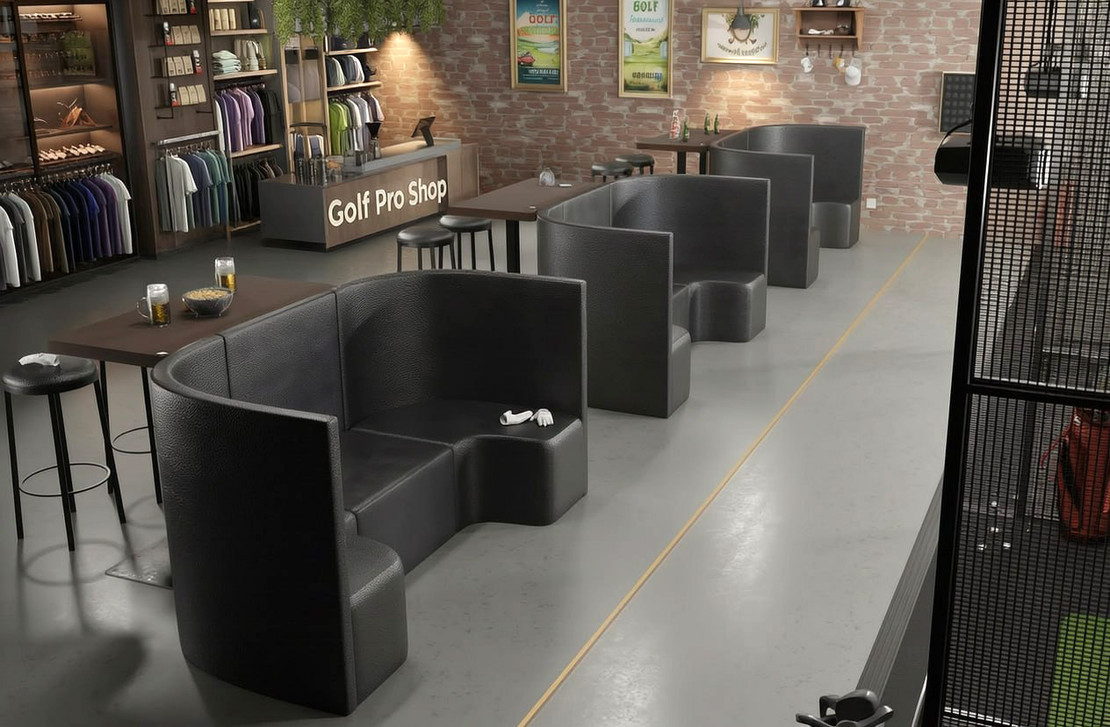
Designing a space-efficient layout with minimal square footage requirements can significantly increase the number of simulator bays within a facility. For example, a U-shape sectional modular lounge seating configuration requires approximately 7.5 feet by 7 feet of space and can accommodate multiple guests comfortably when paired with a bar-height table and stools. In contrast, a traditional straight-line sofa may require up to 9 feet in length while offering less efficient use of space. Unlike a traditional straight-line sofa that may require up to 9 feet in length and runs along the wall, a U-shape sectional utilizes space inward, bringing part of the seating into the layout rather than extending outward. This is a major advantage in tight commercial environments.
These small but strategic design changes allow operators to fit more bays, accommodate more players, and ultimately increase traffic and revenue. Thinking outside the box when it comes to layout and furniture selection provides flexibility and creates a more dynamic and profitable environment.
Q1: Why is space efficiency so important in golf simulator facilities?
Today, real estate costs continue to rise, making every square foot valuable. For golf simulator facilities and entertainment venues, maximizing space directly impacts revenue. The more efficiently a space is designed, the more simulator bays can be installed, allowing operators to serve more customers at the same time. A well-planned layout ensures that no space is wasted and every area contributes to profitability.
Q2: How can furniture design impact the number of simulator bays?
Furniture plays a major role in space planning. Choosing compact and functional seating allows operators to fit more bays within the same footprint. Instead of using long straight-line sofas that extend across the wall and take up more linear space, modular seating solutions provide a smarter alternative. This allows for better use of available square footage and improves overall layout efficiency.
Q3: What is the advantage of using U-shape sectional seating?
A U-shape sectional layout is one of the most effective ways to save space while maximizing seating. Unlike a straight-line sofa that runs across the wall and requires more length, a U-shape sectional uses depth by bringing seating inward. This means part of the seating footprint is utilized inside the layout rather than extending outward, which is a big advantage in tight commercial spaces.
With dimensions around 7.5 feet by 7 feet, this configuration can comfortably accommodate multiple guests while maintaining a compact footprint. When paired with a bar-height table and stools, it creates a complete, functional lounge environment within each simulator bay.
Q4: How does space-efficient design increase revenue?
By reducing the space required per seating area, operators can install more simulator bays within the same facility. More bays mean more players, higher booking capacity, and increased revenue potential. Efficient layouts using solutions like U-shape sectionals allow operators to maximize every inch of the space while maintaining comfort and functionality.
Q5: Why is thinking outside the box important when designing these spaces?
Traditional layouts are not always the most efficient. By thinking outside the box and using modular seating configurations, operators gain flexibility in how they design their space. U-shape sectionals, for example, allow for better space utilization compared to standard sofas, making it possible to increase capacity without expanding square footage. This approach leads to more traffic, better flow, and a more profitable operation overall.