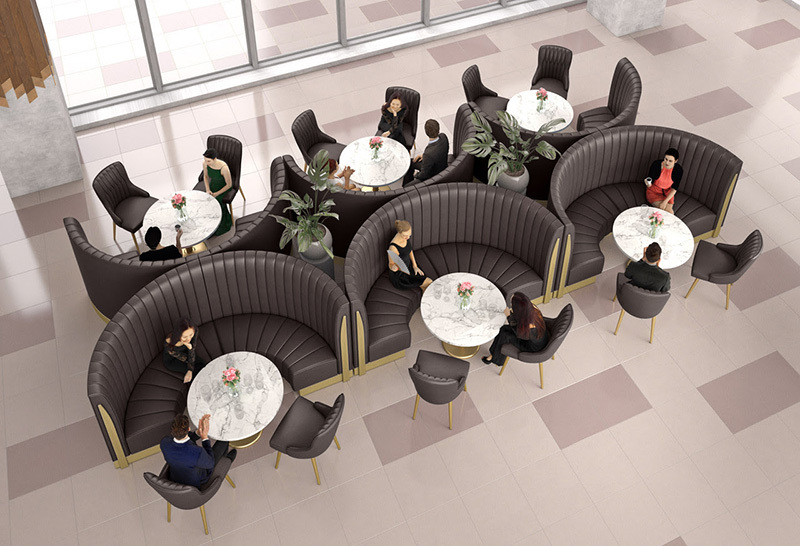
Half-circle booths are among the most visually impressive seating options a restaurant can install. They create a focal point, feel inviting, and naturally encourage group conversation. But while they look simple, they are one of the most misunderstood seating pieces when it comes to layout planning. If placed incorrectly, they can waste valuable square footage, block traffic flow, or make table service uncomfortable.
The most important fact owners must understand is this: a half-circle booth is not just a booth — it is a layout feature. It requires proper table sizing, correct spacing around it, and careful planning of walk paths for guests and servers.
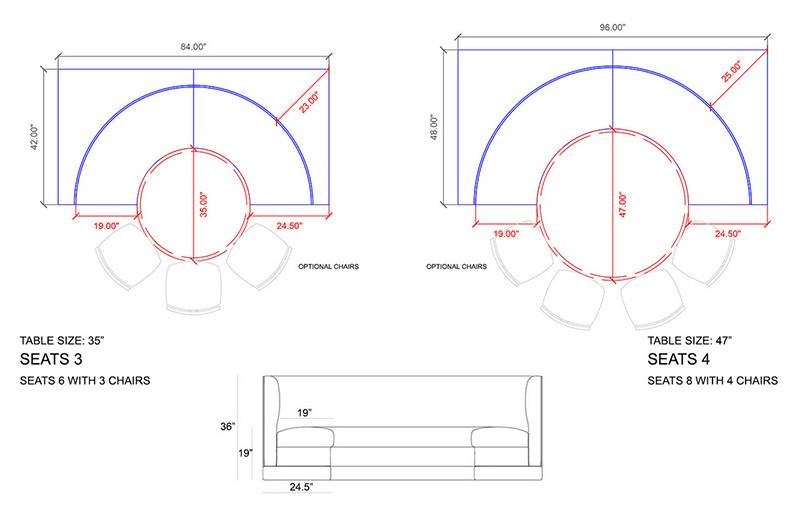
The first mistake many owners make is selecting the wrong table size. A half-circle booth must be paired with a properly sized round table. If the table is too small, guests feel cramped and plates overlap. If the table is too large, guests cannot comfortably reach their food and drinks. The relationship between the booth radius and the table diameter is critical for comfort.
The second factor is clearance space. Unlike straight booths that sit along a wall, half-circles project into the dining area. This means you must leave adequate walking space behind chairs and around the perimeter for servers to move freely. Without this clearance, the booth becomes an obstacle instead of an asset.
Traffic flow is another key consideration. Half-circle booths work best when placed in corners, against glass fronts, along perimeter walls, or as feature pieces in open areas where circulation can happen naturally around them. Dropping them randomly in the middle of a tight floor plan often creates congestion.
Capacity planning is also different. Owners often assume a half-circle seats more guests than it realistically can. In practice, most half-circles are ideal for 4 to 6 guests comfortably. In private dining applications, some layouts can accommodate 6 to 8 guests, creating an exclusive, semi-private experience that guests love. Trying to force more people into the space, however, leads to a poor dining experience.
Table base selection matters too. The best choice is typically a single pedestal base positioned in the center. This allows legroom around the entire curve and prevents guests from fighting table legs when entering or exiting the booth.
Finally, understand the purpose. Half-circle booths are not meant to fill an entire restaurant. They are feature seating elements used to enhance design, create special seating zones, and add character to the layout. They can also be beautifully mixed and matched with single booths, double booths, and wall benches in the same style and finishes to create a cohesive design across the space.
When used strategically, half-circles elevate the dining environment and make a strong design statement while offering guests a memorable, semi-private seating experience.
Q & A — Half-Circle Booth Placement
Q: How many guests can a half-circle booth seat comfortably?
A: Typically 4 to 6 guests. In some private dining layouts, 6 to 8 can work, but comfort and table reach must be considered.
Q: What table shape works best with a half-circle booth?
A: A properly sized round table with a single pedestal base for maximum legroom.
Q: Where should half-circle booths be placed in a restaurant?
A: In corners, along walls, near windows, or open areas where traffic can move around them easily.
Q: Why is spacing around the booth important?
A: Because the booth projects into the floor plan and requires clearance for servers and guest movement.
Q: Can half-circle booths be combined with other seating styles?
A: Yes. They pair very well with single booths, double booths, and wall benches in matching finishes for a unified layout.