When furnishing a commercial facility, "The Human Factor" is the bridge between a beautiful design and a functional business. Whether you are operating a high-turnover restaurant, a high-energy nightclub, or a versatile event space, your furniture is more than just a place for guests to sit—it is a tool that your staff must interact with every single day.
Prioritizing Staff Ergonomics
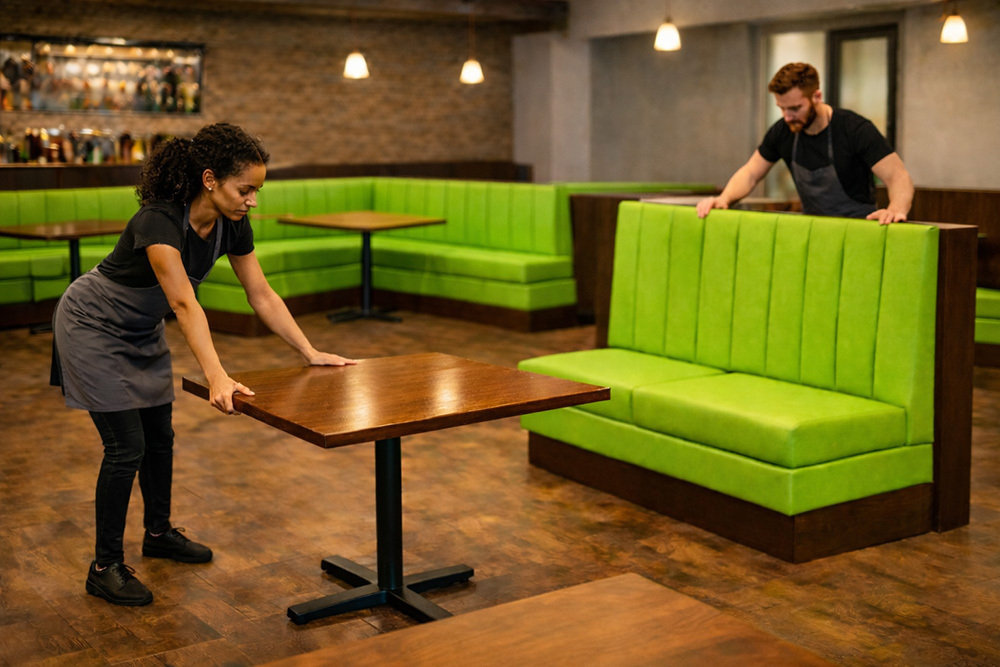
The most successful operators understand that furniture must be "user-friendly" for the people maintaining the space. In a busy restaurant or event venue, furniture is constantly being moved, repositioned for large parties, or flipped for nightly cleaning.
To prevent staff fatigue and workplace injuries, weight is a critical "Human Factor." While commercial furniture must be durable and heavy enough to support various body types safely, individual units like bar stools and restaurant chairs should ideally remain under the 50lb threshold. This allows a single staff member to lift or slide pieces safely. If a chair is too cumbersome, it leads to two problems: dragged feet that ruin your flooring and increased risk of back strain for your team.
Versatility in Nightlife and Events
In the world of nightclubs and event venues, the "Human Factor" shifts toward adaptability. These spaces are dynamic; a floor plan that works for a corporate cocktail hour at 6:00 PM will not work for a VIP bottle service crowd at 11:00 PM.
For these environments, Modular Seating is the gold standard. Operators should look for sectional pieces that feature "quick-connect" or buckling systems. This allows staff to rapidly transform the room into U-shape or L-shape configurations to accommodate different party sizes. When seating is modular and easy to reconnect, your team can respond to guest needs in real-time without needing a construction crew to move the furniture.
The Guest Experience
Finally, the Human Factor considers the guest’s physical comfort. Durable materials don't have to be "hard." The right foam density in a booth or the "eased" edge of a table prevents the physical fatigue that causes guests to leave early. When furniture "works for people," guests stay longer, spend more, and your staff operates at peak efficiency.
5 Common Q&A: The Human Factor in Practice
1. How heavy should my dining chairs be?
Ideally, a standard commercial dining chair should weigh between 20 and 28 lbs. This ensures it is heavy enough to feel "premium" and stable for the guest, but light enough (well under the 50lb safety limit) for staff to move four at a time on a dolly or flip them onto tables for cleaning.
Ideally, a standard commercial dining chair should weigh between 20 and 28 lbs. This ensures it is heavy enough to feel "premium" and stable for the guest, but light enough (well under the 50lb safety limit) for staff to move four at a time on a dolly or flip them onto tables for cleaning.
2. Why is "Modular" better than "Fixed" seating for clubs?
Fixed seating limits your revenue. Modular sofas with hidden ganging clips (buckles) allow you to scale a VIP section up or down instantly. This "Human Factor" ensures your furniture adapts to the group size, rather than forcing a party of ten into a space meant for six.
Fixed seating limits your revenue. Modular sofas with hidden ganging clips (buckles) allow you to scale a VIP section up or down instantly. This "Human Factor" ensures your furniture adapts to the group size, rather than forcing a party of ten into a space meant for six.
3. What is the most important "Human Factor" for bar stools?
Height-to-weight ratio. Because bar stools have a higher center of gravity, they must have a wide enough base to prevent tipping when a guest leans back, yet remain light enough for a bartender to move them easily to mop the footrails.
Height-to-weight ratio. Because bar stools have a higher center of gravity, they must have a wide enough base to prevent tipping when a guest leans back, yet remain light enough for a bartender to move them easily to mop the footrails.
4. How do "Quick-Connect" systems help my bottom line?
They save time. In the event business, "time is labor." If it takes three people 20 minutes to move a heavy sofa, you are losing money. If one person can unbuckle and slide a modular piece in 2 minutes, your labor costs drop and your floor-plan flexibility increases.
They save time. In the event business, "time is labor." If it takes three people 20 minutes to move a heavy sofa, you are losing money. If one person can unbuckle and slide a modular piece in 2 minutes, your labor costs drop and your floor-plan flexibility increases.
5. Will "easy-to-move" furniture look cheap to my guests?
Not if you choose high-quality commercial finishes. Modern engineering allows for lightweight aluminum frames or reinforced polymers that look like heavy wood or steel but offer a much better "Human Factor" for your daily operations.
Not if you choose high-quality commercial finishes. Modern engineering allows for lightweight aluminum frames or reinforced polymers that look like heavy wood or steel but offer a much better "Human Factor" for your daily operations.