What Are the Key Commercial Furniture Interior Design Trends for 2026?
Over the last twenty years, commercial interior design has undergone dramatic and permanent change. Architects and designers have had to continuously adapt—not just to shifting aesthetics, but to how people actually use commercial spaces. Furniture today must support dining, working, socializing, privacy, and technology all at once. What worked two decades ago no longer applies, and those shaping commercial interiors understand this reality better than anyone.
During this period, styles have evolved in cycles. Colors that once faded away are returning with renewed purpose, while materials and finishes have become more sophisticated and performance-driven. “We’ve seen this evolution firsthand,” says Vlad Spivak, CEO of Modern Line Furniture. “Design always comes full circle—but when it returns, it’s smarter, more durable, and more intentional.”
Colors such as Granny Smith Green and Gunmetal Grey—featured in today’s Classic Vinyl Collection—have made a strong comeback, now paired with fabric and commercial vinyl to create bold, refined two-tone upholstery. These combinations deliver visual interest while meeting the performance demands of modern hospitality and commercial environments.
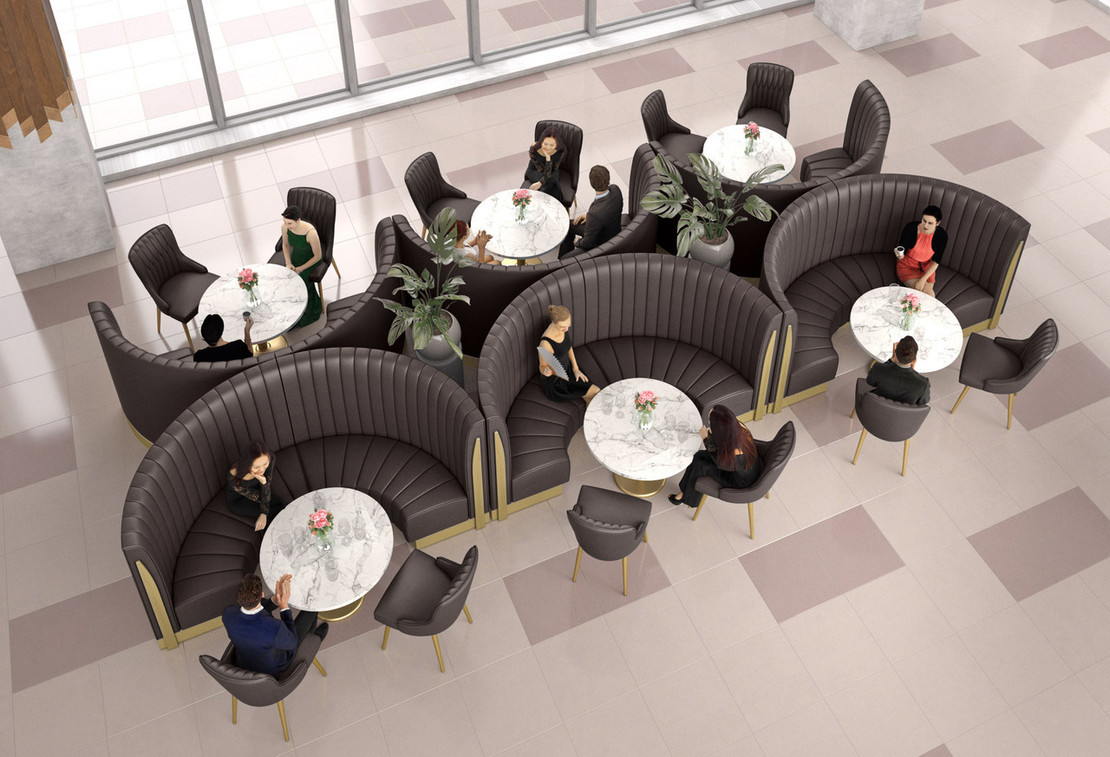
Furniture forms have also changed significantly. Traditional straight-line booth seating once dominated restaurants and dining spaces. Today, designers are increasingly specifying half-circle and radius booths, where curved seating softens interiors, improves traffic flow, and creates more inviting dining experiences. Radius seating has become one of the most requested configurations in recent years, reflecting a clear shift away from rigid layouts.
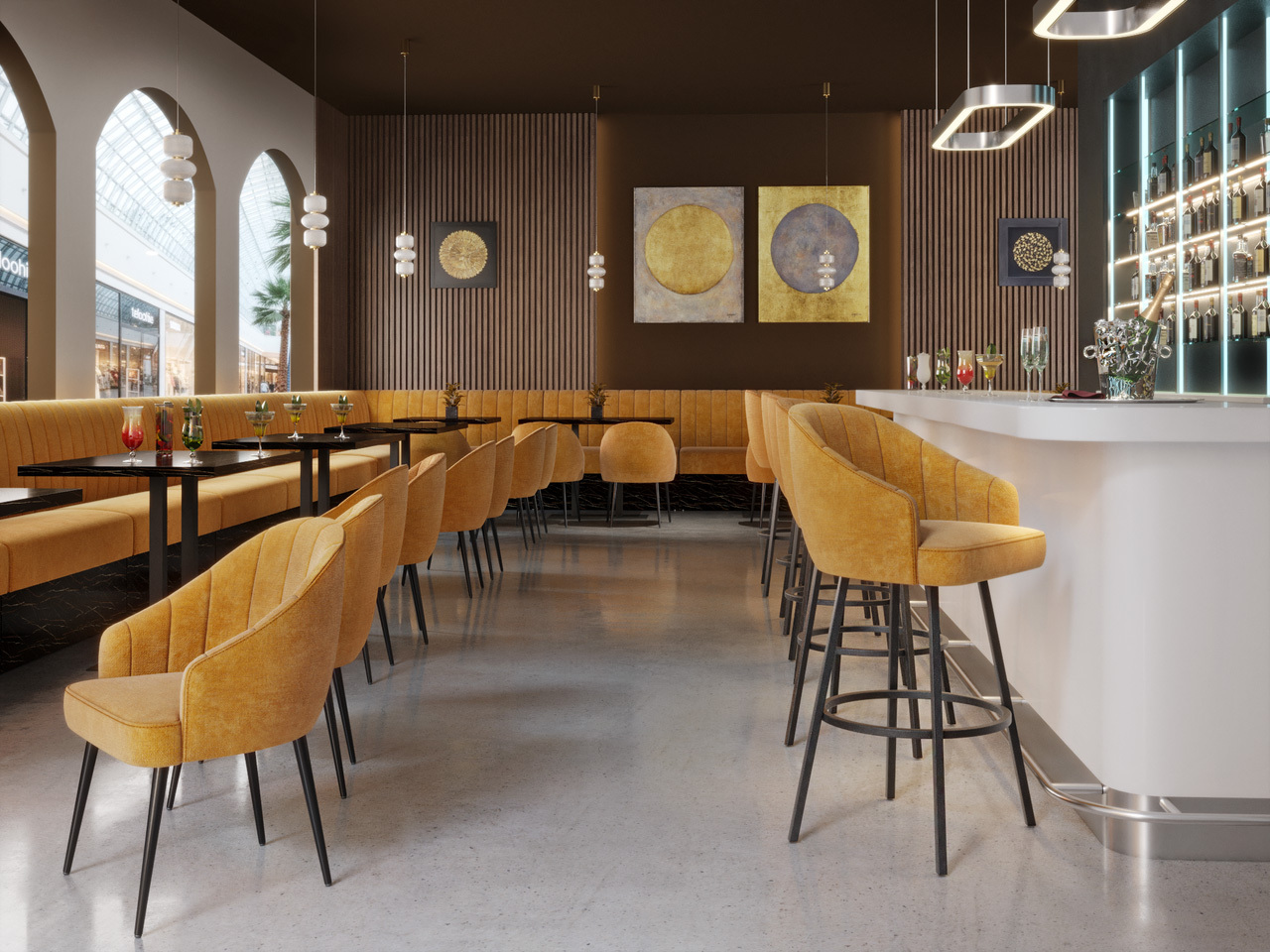
Back panel design has followed a similar trajectory. Flat backs have given way to more expressive treatments, including channel backs and diamond stitching. These details add depth, craftsmanship, and a sense of luxury—elements architects now expect in higher-end commercial projects.
Another major change has been the rise of communal tables. Twenty years ago, they were virtually nonexistent. Today, they are essential, often equipped with integrated power ports and charging stations. These tables support longer stays, shared experiences, and flexible use across food halls, offices, universities, and hospitality venues. Similarly, club chairs have evolved into functional workstations, complete with swing trays and built-in power, allowing guests to work comfortably in lounges and public spaces.
“We’ve been around long enough to see every shift,” Spivak adds. “But more importantly, we’re helping shape what comes next.” Modern Line Furniture’s in-house research and development team works closely with architects and designers who routinely ask for solutions that do not yet exist. From bowling centers to golf facilities, new concepts are continuously prototyped, refined, and brought to market.
New Commercial Furniture Ideas Shaping 2026
As we move toward 2026, architects and designers are no longer looking for furniture that simply fills space. They are asking for pieces that solve problems, adapt to behavior, and support multiple functions within a single footprint. Flexibility, performance, and longevity now drive design decisions more than trends alone.
One of the strongest directions for 2026 is multi-functional seating. Designers want furniture that works throughout the day—seating that transitions seamlessly from dining to working to socializing without requiring layout changes. Lounge seating with integrated power, swing trays, and modular components is becoming standard in hotels, food halls, clubs, and entertainment venues.
Another defining shift is modularity at scale. Architects are specifying systems rather than standalone pieces—modular booths, sectional lounges, and reconfigurable seating walls that can adapt to seasonal layouts, private events, and changing traffic patterns. Furniture in 2026 must support flexibility without requiring full redesigns or replacement.
Material innovation continues to play a central role. Designers are gravitating toward high-performance commercial vinyls and fabrics that offer the softness and look of residential materials while delivering commercial durability. Two-tone upholstery, mixed textures, and contrast finishes are becoming expected rather than optional.
Technology integration is accelerating—but quietly. Power access is now baseline. What’s changing is how it’s incorporated. Designers want charging solutions that are clean, subtle, and integrated—supporting technology without distracting from the design itself.
Privacy is another growing priority. Open floor plans remain popular, but guests increasingly want personal space within them. High-back seating, curved booths, and semi-enclosed lounge arrangements are now essential tools to control acoustics and create comfort without walls. In 2026, privacy will be achieved through furniture design.
Finally, designers are demanding faster customization and shorter lead times. Domestic manufacturing, rapid prototyping, and in-house upholstery are becoming decisive advantages. The ability to adjust dimensions, finishes, and layouts quickly is no longer a luxury—it’s an expectation.
What’s Coming in 2026 Based on What We’re Seeing Today
The most important question architects and designers are asking today is not what looks good now—but what will still perform five years from now. Based on daily conversations with designers, operators, and developers, clear patterns are emerging that define 2026.
Furniture will be designed for intentional flexibility, supporting multiple uses across different times of day. Seating will be expected to provide comfort for longer stays, whether guests are dining, working, or socializing. High-density foam, supportive ergonomics, and proper seat heights will become standard.
Controlled privacy will continue to grow. High-back seating and curved forms will dominate hospitality and public interiors, creating VIP-style zones without closing off spaces. Material selection will emphasize performance—high double-rub vinyls, water-resistant fabrics, and bleach-cleanable surfaces.
Technology will be everywhere—but invisible. Integrated power will be expected across tables, lounges, and seating systems. And most importantly, furniture will be judged not by appearance alone, but by how well it supports experience.
Looking Ahead to 2026
Taking everything we’ve seen, built, and learned over the past two decades, the direction for 2026 becomes clear. Color palettes will move toward exotic, glossy finishes, with materials from the Glaze Vinyl Collection leading the way. Rich tones like Honey and Sangria Glaze will act as focal points—designed to energize interiors and encourage guests to stay longer.
Performance fabrics such as Como fabric will gain popularity by delivering residential comfort with commercial durability. Its water-resistant properties allow liquids to bead and run off, making it ideal for hospitality environments.
Another standout for 2026 is Kelton vinyl, which replicates the look of genuine cowhide leather while offering superior durability for high-traffic spaces.
Classic details are also returning. Button-tufted back panels remain timeless and will continue to reappear, while high-back seating becomes standard—supporting privacy, group dining, and VIP experiences.
Finally, charging stations will be part of nearly every furniture piece, reflecting how people dine, work, and socialize today.
Architects and designers in 2026 are not chasing trends—they are designing for experience, longevity, and adaptability. And furniture manufacturers who understand this shift will help define the next era of commercial interiors.