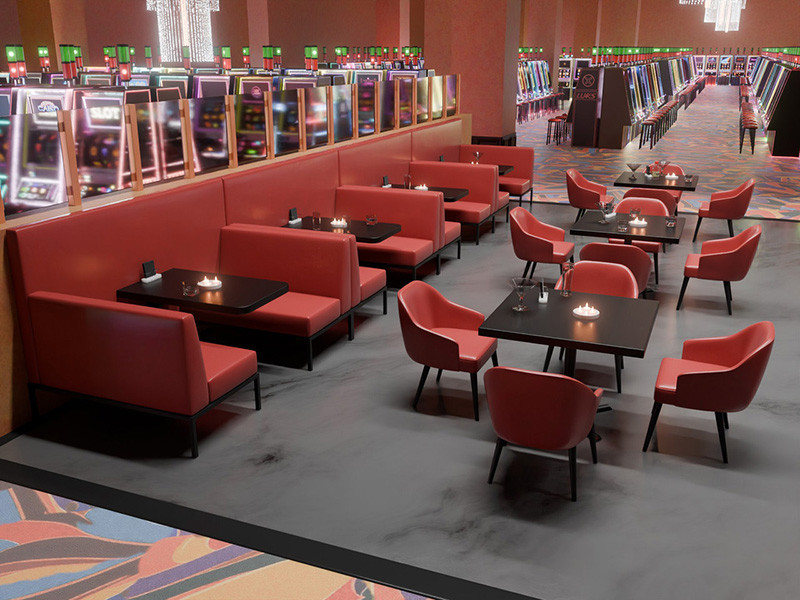
Seating Capacity vs. Floor Space – Key Answers
When choosing between booths, tables, and chairs, restaurant owners must balance three critical factors: spatial efficiency, guest comfort, and operational flexibility. Every seating decision directly affects revenue per square foot, guest behavior, staff efficiency, and long-term maintenance costs. The right mix of seating types can dramatically improve both the dining experience and overall profitability.
1. Seating Capacity vs. Floor Space
One of the primary goals in restaurant planning is maximizing the revenue-generating area without creating an overcrowded or uncomfortable environment.
Booth Efficiency
Booths are among the most space-efficient seating options available. A standard four-person booth typically requires approximately 3,000 square inches, while a comparable four-person table and chair setup can exceed 5,000 square inches once chair pull-back and circulation space are accounted for. Because booths eliminate chair movement, they allow tighter, more predictable layouts.
Capacity Boost
Replacing standard tables with booths can increase seating capacity — and potential revenue — by up to 30%, especially during peak dining hours. More seats in the same footprint means higher table turns without expanding square footage.
Quick Capacity Formula
A commonly used planning guideline is to divide usable dining space by 15–20 square feet per seat. This quick calculation helps owners estimate how many guests can be seated comfortably without sacrificing circulation or service flow.
2. Guest Comfort and Seating Psychology
Seating choice doesn’t just affect layout — it directly influences how guests behave and how much they spend.
The “Anchoring” Effect
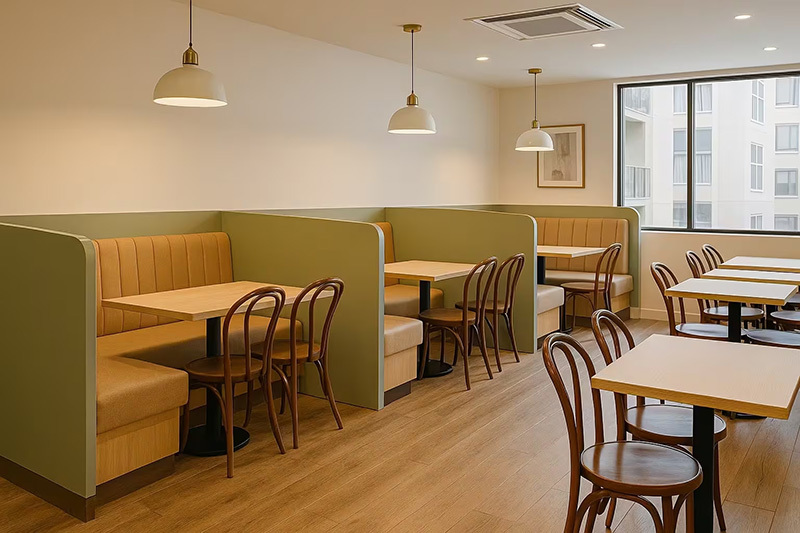
Guests seated at “anchored” locations — such as booths or tables placed against walls — feel more private and secure. These guests tend to stay longer and are statistically more likely to order appetizers, desserts, and additional beverages compared to diners seated at exposed center tables.
Privacy & Acoustics
High-back booths provide visual separation and act as sound buffers. This makes them ideal for:
-
Romantic dinners
-
Business meetings
-
Families with children
By reducing noise and visual distractions, booths improve perceived comfort even in busy dining rooms.
Accessibility Considerations
While booths offer comfort and privacy, tables and chairs remain essential for ADA compliance and inclusivity. Chairs are easier to accommodate guests using mobility devices and those who prefer adjustable seating. A balanced layout ensures all guests feel welcome.
3. Operational Flexibility and Maintenance
Daily operations should always factor into seating decisions, not just opening-day aesthetics.
Fixed vs. Flexible Seating
Tables and chairs provide flexibility. They can be rearranged to accommodate large parties or special events, but this flexibility comes at a cost. Staff must spend time moving furniture and resetting the floor after each service. Booths, by contrast, are fixed in place. While less flexible, they create a predictable layout that speeds up service and reduces staff labor.
Cleaning & Maintenance
Tables are easier to move for floor cleaning, while booths — especially upholstered ones — can collect crumbs and require more detailed upkeep over time. However, booths often require less frequent replacement compared to chairs, which suffer from constant dragging, scuffing, and joint stress.
Durability Advantage
Because booths are stationary, they experience significantly less mechanical wear than chairs. Over the long term, this often results in lower replacement and repair costs.
4. Technical Specifications & Planning Dimensions
Before purchasing any seating, owners should review standard dimensions to ensure comfort, safety, and code compliance.
Industry Standards to Know
-
Standard booth seat height: 18 inches from the finished floor
-
Main walkway clearance: Minimum 36 inches for safe guest and server movement
-
Back-to-back seating clearance: Approximately 18 inches between seated guests to prevent bumping
These dimensions ensure ergonomic comfort while maintaining efficient service flow.
Smart Space-Saving Layout Solutions
Sometimes traditional straight booths are not enough to fully optimize a space. Half-circle booths can be extremely effective in corner areas, allowing seating where square layouts would waste space. Wall benches can run seamlessly to columns and continue on the other side, maximizing linear wall space that might otherwise go unused.
These design strategies are especially useful in irregular floor plans or older buildings where columns and corners limit standard layouts.
Final Takeaway
Maximizing seating capacity without sacrificing comfort requires thoughtful planning. Booths offer unmatched efficiency and revenue potential, tables and chairs provide flexibility and accessibility, and specialty layouts help reclaim underutilized space. The most successful restaurants combine all three strategically, guided by accurate dimensions and realistic operational needs.
For layout planning, spacing verification, and seating footprints, visit our AutoCAD Space Planning Page for more Info:
https://www.