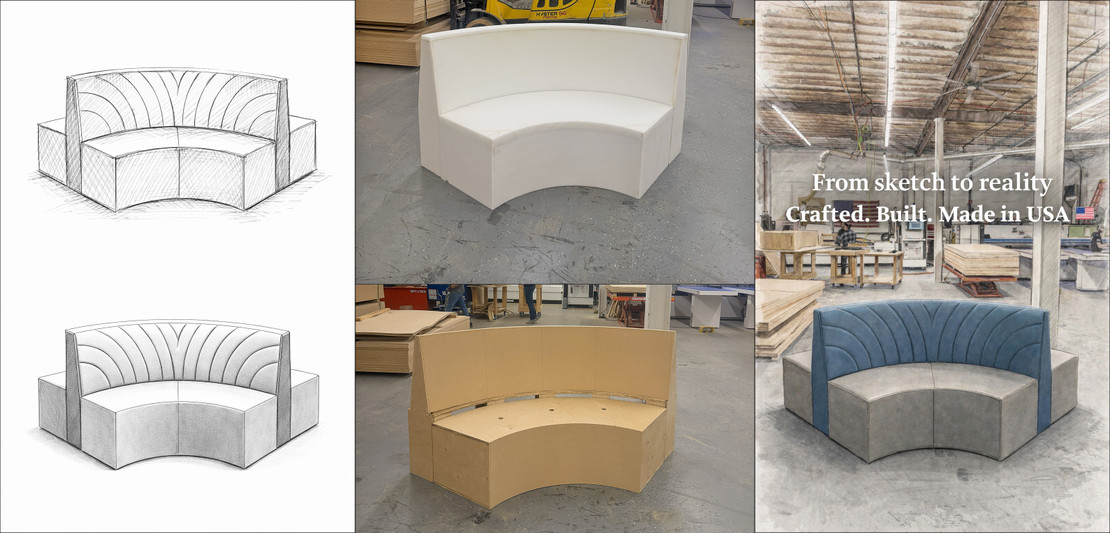
How to Furnish a Commercial Space with Custom-Size Furniture
Furnishing a commercial space—whether a restaurant, lounge, nightclub, or hospitality venue—requires more planning than simply selecting furniture from a catalog. When layouts are tight, walls are irregular, or seating capacity directly impacts revenue, custom-size furniture becomes less of a luxury and more of a necessity. Understanding how custom furniture works, when it is required, and how to approach the process correctly can make the difference between a space that merely looks complete and one that performs at its highest potential.
In today’s market, real estate costs continue to rise, and every square foot carries real value. For restaurant and lounge operators, this puts constant pressure on floor plans to work harder. Empty gaps, awkward furniture placement, or unused wall lengths translate directly into lost seating—and ultimately lost revenue. Custom-size furniture addresses this challenge by allowing the space to dictate the furniture dimensions, rather than forcing the space to conform to standard sizes.
Many commercial buyers are comfortable working with standard furniture dimensions. In the restaurant industry, it is commonly understood that a 48-inch bench typically seats two guests, while a 60-inch booth accommodates three. These standards make purchasing straightforward when layouts are predictable. However, most commercial interiors are far from perfect rectangles. Structural columns, uneven walls, angled corners, and long uninterrupted wall runs create conditions where standard sizes fall short.
A common example is a straight wall banquette measuring 24 feet and 5 inches in total length. Relying only on standard-size bench units almost always leaves a small gap at the end of the run. While the gap may seem minor, it quickly becomes both a design and operational issue. Some operators attempt to solve this by adding a small table, planter, or filler panel. Although this may visually close the space, it does not generate revenue and often disrupts the rhythm of the seating line.
More importantly, these filler solutions tend to draw attention for the wrong reasons. Instead of a clean, continuous banquette that appears intentional and built-in, the space ends with an element that feels improvised. In hospitality design, guests notice these inconsistencies—even if they cannot articulate exactly what feels off. Furniture that fails to align properly with the architecture of the room weakens the overall design and experience.
Custom-size furniture solves this problem by allowing one or more pieces to be built specifically to fill exact dimensions. Rather than making every unit custom, a more strategic and cost-effective approach is to use standard sizes for most of the run and introduce a single custom-size unit to eliminate the gap. This method preserves budget efficiency while achieving a seamless, uniform appearance.
This hybrid approach—combining standard and custom units—is especially effective for wall benches, banquettes, and booth lines. It allows operators to maintain predictable pricing on most pieces while addressing layout challenges only where necessary. From an economic standpoint, this is far more efficient than making an entire seating line custom, and it delivers a stronger visual and functional result than leaving dead space unused.
Customization also presents an opportunity to elevate the design without complicating the project. When a single custom unit is introduced, subtle enhancements can be applied across the entire seating line. Adjustments such as a slightly taller back panel, custom stitching patterns, or tailored upholstery details add visual interest while maintaining consistency. These refinements help the furniture feel intentional and integrated rather than assembled from mismatched components.
Material selection plays a major role in custom commercial furniture, particularly in hospitality environments. Designers and architects often specify Client’s Own Material (COM) to align furniture with the broader interior palette. Working with COM requires experience, coordination, and an understanding of performance requirements. Not all manufacturers are equipped to handle COM efficiently, but when done correctly, it provides greater control over texture, color, and brand expression.
Custom-size furniture is also critical when pieces must integrate tightly with architectural elements. Columns, wall panels, millwork, and lighting features often require furniture to align precisely to maintain clean sightlines and consistent proportions. Off-the-shelf furniture rarely accounts for these details. Custom sizing ensures the furniture feels like part of the architecture rather than something placed inside it.
Despite its advantages, custom-size furniture is often misunderstood. Some buyers assume it is overly complex, expensive, or time-consuming. In reality, the process becomes straightforward when handled by a manufacturer that produces furniture in-house. Direct control over fabrication allows custom pieces to be designed, built, and matched seamlessly with standard units, reducing lead times and minimizing errors.
Success with custom furniture begins with clarity. Accurate measurements, a well-defined layout, and open communication between the operator, designer, and manufacturer ensure that custom pieces solve problems rather than create new ones. When approached correctly, custom-size furniture does not complicate a project—it simplifies it.
Ultimately, furnishing a commercial space with custom-size furniture is about maximizing both function and return on investment. Every inch matters, not only in seating capacity, but in how a space looks, feels, and performs. Custom solutions allow operators to eliminate wasted space, create cohesive interiors, and support long-term operational success.
In an industry where margins are tight and competition is high, thoughtful furniture planning is no longer optional. Custom-size furniture provides the flexibility needed to adapt to real-world spaces, making it an essential tool for restaurants, lounges, nightclubs, and hospitality venues focused on efficiency, design integrity, and profitability.
Q: Why is custom-size furniture important in commercial spaces?
A: Custom-size furniture allows the layout of the space to dictate the furniture dimensions, eliminating wasted areas and improving seating efficiency. In restaurants and hospitality venues where every square foot impacts revenue, custom sizing helps maximize capacity while maintaining comfort and proper traffic flow.
Q: When should a restaurant or lounge consider custom-size furniture instead of standard sizes?
A: Custom furniture becomes necessary when spaces include long wall runs, irregular dimensions, columns, angled walls, or tight layouts where standard furniture sizes leave gaps or disrupt the design.
Q: Do all furniture pieces need to be custom-made to achieve a good layout?
A: No. A cost-effective approach is to combine standard-size units with one or two custom-size pieces. This hybrid method closes layout gaps, maintains design continuity, and controls overall project cost.
Q: How does custom-size furniture help increase revenue?
A: By eliminating dead space and maximizing usable seating, custom furniture allows operators to add seats where standard furniture cannot, directly increasing earning potential without expanding the footprint.
Q: Can custom-size furniture still match standard pieces visually?
A: Yes. Custom units are designed to align seamlessly with standard pieces, maintaining uniform heights, upholstery, stitching, and proportions so the seating line appears continuous and intentional.
Q: Is custom-size furniture more complicated or expensive to manage?
A: When produced by an in-house manufacturer, custom furniture is a streamlined process. Accurate measurements, clear layouts, and direct collaboration reduce complexity while delivering long-term value and better space performance.