Custom Contract Furniture Built to Specification: How Commercial Spaces Bring Custom Ideas to Life
Custom contract furniture plays a critical role in shaping how commercial spaces function, flow, and perform. Unlike ready-made products selected from catalogs, custom contract furniture is built to specification—designed around the exact needs of the environment it serves. From public seating and restaurants to golf simulators, bowling centers, lounges, and entertainment venues, no two spaces operate the same way, and furniture must respond accordingly.
Most custom projects begin the same way: a client reaches out asking whether custom commercial furniture can be designed and manufactured for their project. The first step is not choosing finishes or styles, but understanding what type of furniture is needed and where it will be placed. Traffic levels, usage patterns, layout constraints, and aesthetic goals all influence how a piece should be designed.
What “Built to Specification” Really Means
In contract manufacturing, “built to specification” means every element of the furniture is intentionally engineered. Dimensions are tailored to floor plans rather than adjusted to fit them. Materials are selected based on performance requirements, not just appearance. Upholstery, foam density, frame construction, and stitching details are all determined by how the furniture will be used day after day.
A restaurant booth designed for fast-paced dining requires different construction than lounge seating in a cocktail area. Public seating demands durability and flexibility, while VIP zones often prioritize comfort, scale, and visual impact. Custom contract furniture allows each of these needs to be addressed without compromise.
The Custom Contract Furniture Process
The custom process begins with defining the application. Clients are asked where the furniture will be used, how many people it must accommodate, and what level of traffic it will endure. From there, layouts and configurations are developed to support movement, spacing, and functionality within the space.
Once the concept is established, details such as dimensions, materials, upholstery, and finishes are refined. Customer’s Own Material (COM) is often incorporated, along with custom stitching, channeling, tufting, or unique panel details. Because these projects are one-of-a-kind, pricing is calculated individually based on scope, materials, and complexity rather than listed online.
Over time, many custom-built seating groupings developed for specific projects evolve into complete furniture packages. These proven layouts reflect real-world performance and often become repeatable solutions for similar environments.
Where Custom Contract Furniture Is Used
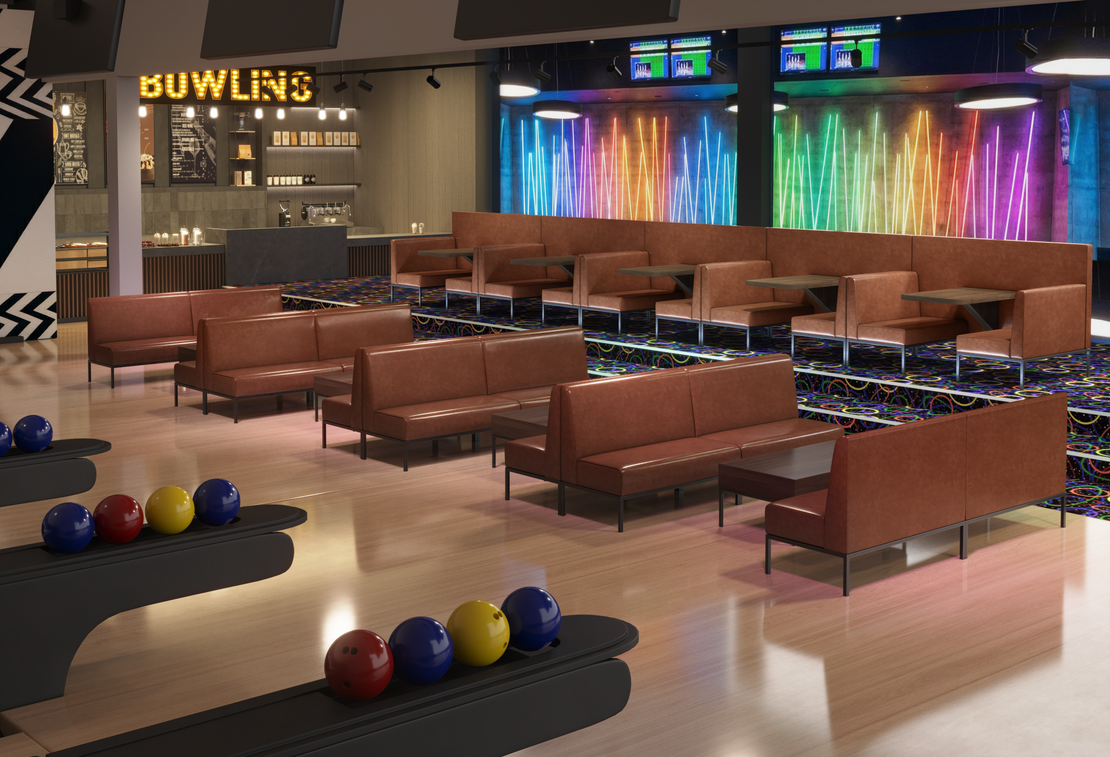
Custom contract furniture is commonly found across a wide range of commercial environments. Restaurants rely on it to maximize seating while maintaining comfort and durability. Public seating areas require modularity and resilience. Golf simulators and bowling centers combine social seating with sightline considerations and extended dwell times.
Lounges, entertainment venues, and hospitality spaces use custom furniture to establish identity and atmosphere while still meeting commercial performance standards. In each case, the furniture must align with both operational needs and the visual language of the space.
Durability Meets Design
A common misconception is that custom furniture is primarily decorative. In reality, custom contract furniture is engineered to withstand daily commercial use. Reinforced frames, commercial-grade foam, and performance upholstery are standard components, regardless of the design style.
While the appearance may be refined or design-forward, the construction remains focused on longevity and reliability. This balance allows custom furniture to enhance guest experience without sacrificing durability.
Is Custom Furniture More Complex to Manufacture?
Yes, custom furniture is more involved than standard production. Building furniture from scratch requires sample development, new templates, and additional labor hours. Engineering and prototyping are often necessary to ensure the design performs as intended.
This added complexity increases production time and cost, but it also ensures accuracy. Furniture built to specification fits the space correctly, functions as intended, and meets both aesthetic and performance expectations. For commercial projects, this precision often prevents costly revisions or compromises later.
Collaboration Is Key
Custom contract furniture is a collaborative process. Designers, operators, and manufacturers work together to align furniture with the overall interior concept. Understanding the complete environment—lighting, finishes, circulation, and usage—helps ensure the furniture integrates seamlessly into the space.
Direct consultation during the design phase allows potential issues to be addressed early and ensures the final product supports both form and function. This approach leads to cohesive, intentional spaces rather than furniture that feels added after the fact.
Why Custom Contract Furniture Matters
In commercial environments, furniture is more than seating—it influences how people interact with the space. Custom contract furniture allows spaces to operate efficiently while reinforcing brand identity and guest experience. By being built to specification, each piece supports the unique demands of the environment it serves.
Whether the goal is maximizing capacity, improving comfort, or creating a distinctive atmosphere, custom contract furniture provides solutions that standard products simply cannot. It transforms ideas into production-ready pieces designed to perform reliably in real-world commercial settings.
For more info visit our contract Furniture page https://www.